W213 is the standard-wheelbase, four-door saloon of this E-Class generation. The estate is S213, the long-wheelbase saloon V213, the two-door coupé C238 and the cabriolet A238. Sources

Two chambers in front, three behind
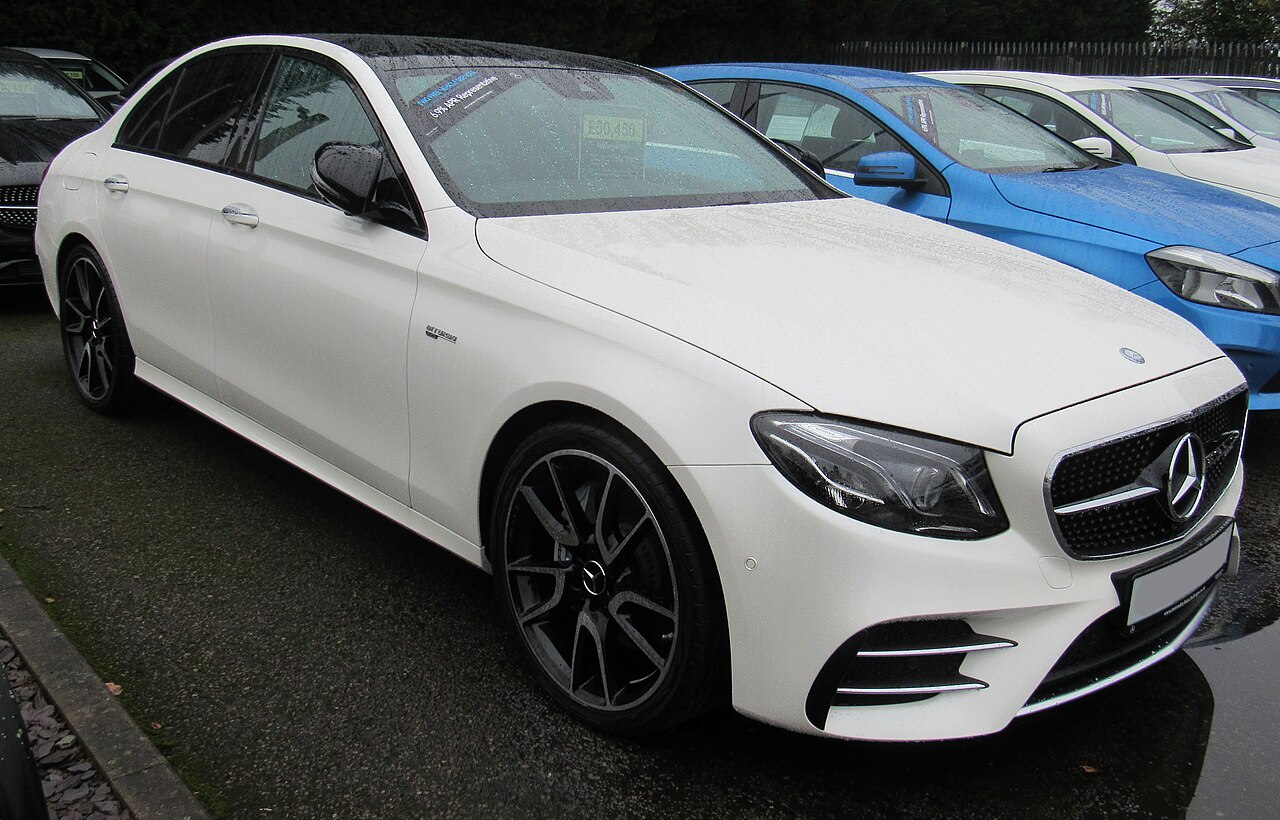
The original W213 offered AIR BODY CONTROL as an optional four-wheel air suspension in Mercedes-Benz’s 2016 US technical description. Each front air-spring strut had two chambers, while each rear strut had three chambers of different sizes. The multi-chamber arrangement allowed the system to vary spring firmness in three stages, combining a soft basic setting with firmer support as driving conditions demanded.
This was not just a device for raising or lowering the car. Its variable spring rate changed how firmly the springs resisted suspension movement. Separately, ADS PLUS adaptive damping continuously adjusted damping force; the electronically controlled dampers adapted at each wheel to the road and driving situation. The owner’s manual lists variable-rate air springs and ADS PLUS as distinct parts of AIR BODY CONTROL. Sources
Ride-height control did another job. All-round self-levelling maintained the car’s level when loaded, while speed-dependent lowering reduced aerodynamic resistance at higher speeds. The driver could also increase ground clearance for rough roads. Spring firmness, damping and ride height were therefore three related controls—not three names for the same adjustment. Sources
The Hong Kong E 43 provides a local example
The Mercedes-AMG E 43 4MATIC used an AMG-specific suspension based on AIR BODY CONTROL. Mercedes-AMG described multi-chamber air springs, continuously variable damping and pneumatic self-levelling at both axles. Its dampers used separate valves for rebound and compression, with Comfort, Sport and Sport+ settings.
A Hong Kong road test published on 18 April 2017 identified the E 43’s suspension as an AMG-developed version of Air Body Control and reported a broad difference between its comfortable and firmer settings. Sources
E 63 S: a V8 that can work on four cylinders
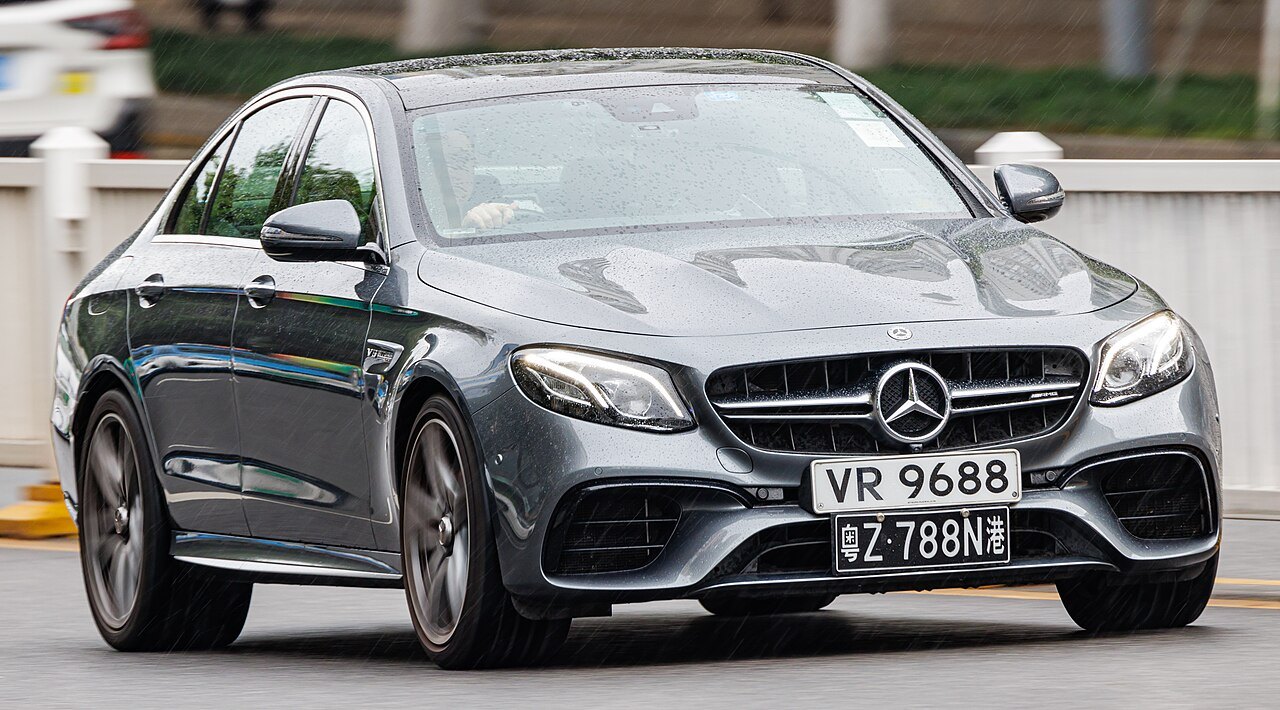

The pre-facelift Mercedes-AMG E 63 S saloon could deactivate half its cylinders under light load. CAMTRONIC moved sliding cam units to keep the intake and exhaust valves of cylinders 2, 3, 5 and 8 closed, while their fuel supply and ignition were switched off. The other four cylinders continued working at a higher-load operating point, improving their efficiency while reducing gas-exchange losses in the inactive cylinders. This was more than simply withholding fuel while all eight cylinders continued opening their valves normally. Sources
The system was available in Comfort between 1,000 and 3,250 rpm, with the instrument display showing four- or eight-cylinder operation. It responded to load as well as engine speed: that rpm range did not mean the V8 always ran on four cylinders. A 27 July 2017 Hong Kong E 63 S test documented the same cylinder numbers, valve control and Comfort operating range. Sources
Twin-scroll: keeping exhaust pulses apart
The same E 63 S used two twin-scroll turbochargers. Each turbine housing contained two parallel flow passages, supplied by separate exhaust-manifold ducts. Keeping the exhaust pulse groups apart reduced their interference with one another during gas exchange, lowering exhaust back pressure and helping cylinder filling and low-rev response. Sources
The turbochargers sat between the two cylinder banks, the arrangement known as the hot inner V. That described their location; twin-scroll described how exhaust reached their turbines. The contemporary Hong Kong E 63 S review also explained the separate exhaust ducts, providing a local example of this particular V8 installation. Sources
MCT: a different way to pull away
The pre-facelift E 63 S used the nine-speed AMG SPEEDSHIFT MCT, whose wet starting clutch replaced the torque converter. Mercedes-AMG attributed lower weight and sharper response to accelerator inputs and load changes to this arrangement; the July 2017 Hong Kong test also identified the clutch-based starting system. See AMG MCT: a starting clutch instead of a torque converter. Sources
E350e: an accelerator that talks back
The pre-facelift E350e plug-in hybrid used a haptic accelerator pedal to communicate with the driver’s right foot. A resistance point marked the available electric power: pushing beyond it requested the petrol engine’s participation. A separate double pulse prompted the driver to lift off when the proximity-warning system identified a slower vehicle ahead, after which the electric motor could act as a generator to slow the car and recover energy. One cue concerned requested power; the other concerned traffic ahead. Sources
A 20 March 2017 Hong Kong E350e test described both the pedal’s resistance and its two lift-off pulses. On hills or when stronger acceleration was needed, the reviewer repeatedly pressed through the resistance point to call on the engine. The pedal made that choice tangible without requiring a glance at the energy display. Sources
E53: one electric helper for torque, another for intake air
The pre-facelift Mercedes-AMG E53 4MATIC+ saloon’s M256 engine divided two jobs between separate electrical devices. Its EQ Boost integrated starter-generator, between engine and transmission, restarted the engine, supplied torque assistance and recovered energy. The electric auxiliary compressor built intake pressure while the exhaust-driven turbocharger was becoming effective. See the S500 explanation of ISG and electric-compressor roles for the shared operating principle. Sources
The 8 January 2019 Hong Kong E53 saloon test identified both devices and reported immediate accelerator response, while finding little separately perceptible sensation from the ISG’s assistance and charging. The display could show those electrical transitions even when the driver barely felt them. Sources
PRE-SAFE Impulse Side moves the occupant before impact
On original W213 saloons equipped with PRE-SAFE Impulse Side, an impending side collision could trigger an air chamber in the front-seat backrest bolster nearest the threatened side. Inflating it moved the occupant’s upper body inward, increasing the distance from the door before the impact. Mercedes-Benz’s 2016 US description placed this pre-crash positioning function in Driver Assistance Package Plus. Sources
The seat specification mattered. The US model-year 2020 brochure explicitly excluded the function with AMG Performance front seats, whose selection deleted Impulse Side from the assistance package. Sources
Frontbass: using space inside the body
The original W213’s US technical material also documents Frontbass, using space in the body’s cross-member and side member as resonance chambers for the bass speakers. It describes that architecture separately from the optional Burmester systems. See how Frontbass uses the body structure. Sources
Hong Kong: introduction and facelift
| Date | Documented local milestone Sources |
|---|---|
| 2016‑06 | Mercedes-Benz Hong Kong held the original saloon’s launch at West Kowloon Cultural District on 24 June, followed by a public event on 25–27 June. The accompanying local price list included E 200 Avantgarde/Exclusive, E 300 Avantgarde/Exclusive and E 400 4MATIC Exclusive. |
| By 2017‑03‑03 | A local report listed the Mercedes-AMG E 43 4MATIC saloon from HK$999,900. This establishes an offering by that date, rather than a first-delivery date. |
| 2020‑09 | A report dated 18 September documented the facelift’s arrival in Hong Kong, listing E 200 Exclusive/AMG Line and E 300 AMG Line, from HK$579,000. |
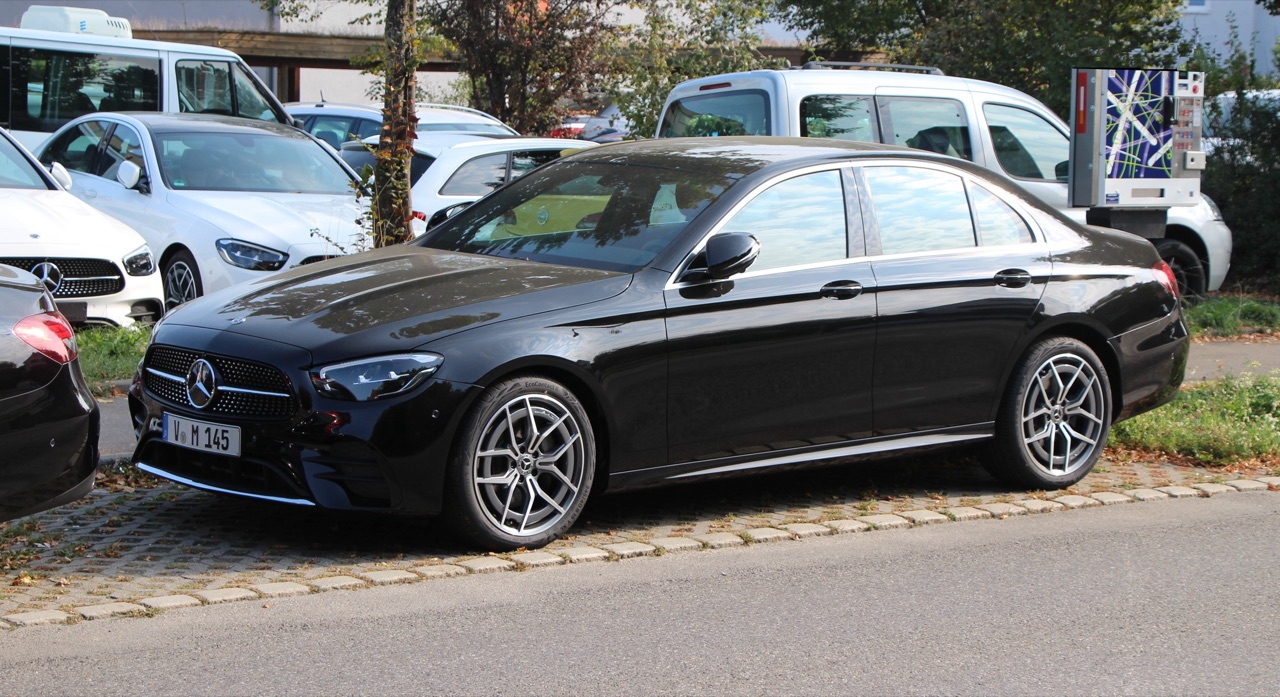
The local facelift report highlighted new headlamps, tail lamps, grille and bumpers, alongside MBUX and twin 12.3-inch displays. Sources

Hands-on detection without a steering nudge
For the facelift’s new steering-wheel generation, Mercedes-Benz’s 2020 US description explains a change in how the assistance systems recognised a driver’s hands. Earlier feedback required a small steering movement. A capacitive sensor pad in the rim could instead detect that the driver was holding it, so a deliberate nudge was no longer necessary to confirm contact. This rim sensor performed a different job from the Touch Control buttons on the spokes: it checked hand contact while the assistance system operated. Sources
An exit warning that stays awake after ignition-off
On facelift W213 saloons equipped with Active Blind Spot Assist with exit warning, stopping the car did not end the system’s work. Mercedes-Benz’s 2020 US technical description explains that it could warn occupants through the exterior mirror when a vehicle or bicycle passed through the critical area beside the stationary car. If the driver then used the door handle, an audible warning and flashing red ambient door lighting added a more urgent cue. The function remained available for up to three minutes after the ignition was switched off. Its job was to warn before opening into passing traffic. Sources
Sources
- Mercedes-Benz, digital rescue-sheet index, entries for W213, S213, V213, C238 and A238. Body identification, not Hong Kong launch dates.
- Mercedes-Benz USA, The all-new Mercedes-Benz E-Class, 23 September 2016. “AIR BODY CONTROL air suspension,” “Three-dimensional listening pleasure” and “PRE-SAFE Impulse Side”; original US saloon spring/damper architecture, Frontbass and front-seat pre-crash positioning in Driver Assistance Package Plus.
- Mercedes-Benz, E-Class Owner’s Manual, 2135844604Z102, September 2016 edition, printed pp. 205–206. German-market manual covering equipment-dependent functions; variable spring rate and ADS PLUS.
- Mercedes-AMG / Mercedes-Benz USA, The new Mercedes-AMG E43, 23 September 2016. “AMG Sport Suspension based on AIR BODY CONTROL”; AMG-specific springs, damping valves and levelling.
- James Chan, Car1.hk, Mercedes-AMG E 43 4MATIC 令人心跳快了點, 18 April 2017. Local test-car suspension and driving impressions.
- Car1.hk, 全新平治 E-Class 城中最智能行政房車體驗活動, 26 June 2016, including its linked price/specification table. Hong Kong event dates and listed sales variants.
- Car1.hk, Mercedes-AMG E 43 房車 $999,900 起, 3 March 2017. Dated Hong Kong offering and price.
- Car1.hk, 【新車預覽】Mercedes-Benz E-Class 新款抵港 $579,000 起, 18 September 2020, including its linked E 200/E 300 specification table. Hong Kong facelift arrival, variants and cabin changes.
- Mercedes-AMG / Mercedes-Benz USA, The new 2018 Mercedes-AMG E63 S Sedan, 25 October 2016. “AMG Cylinder Management,” “Valves closed, fuel supply and ignition deactivated,” “New peak of performance: 4.0L V8 biturbo engine with twin-scroll turbochargers” and “Short shift times, high efficiency: the AMG SPEEDSHIFT MCT nine-speed sport transmission.” Original-phase E63 S saloon engineering; the title’s 2018 is US model-year naming.
- James Chan, Car1.hk, Mercedes-AMG E 63 S 4MATIC+ 超急房跑, 27 July 2017. Hong Kong E63 S test documenting cylinder management, separate twin-scroll exhaust ducts and nine-speed MCT starting-clutch architecture.
- Mercedes-Benz USA, The new E-Class: Intelligence that excites, 3 March 2020, “Active Blind Spot Assist” in the driving-assistance section. US facelift saloon/estate description: capacitive steering-rim contact sensing versus earlier steering-movement feedback; mirror warning for passing vehicles/bicycles, driver-door-handle-triggered audible and red ambient-light warning, passing-road-user threshold above 5 mph and availability up to three minutes after ignition-off.
- Daimler AG, International Corporate Sales, July 2016 edition, editorial deadline 20 June 2016, printed p.13, “Plug-in-hybrid – The future inside.” Manufacturer booklet preserved as third-party transcription: E350e saloon pressure point, double-pulse prompt for a slower vehicle ahead and generator deceleration. An original scan has not been visually authenticated.
- Mercedes-Benz Thailand, The E-Class Saloon, September 2017, PDF p.7, E-MODE. Original Thai-market manufacturer brochure, dealer-hosted; independently corroborates haptic-pedal resistance and engine intervention.
- James Chan, Car1.hk, Mercedes-Benz E350e Plug-in Hybrid 憑智慧減省資源, 20 March 2017. Hong Kong test observations of pressure-point resistance and two lift-off pulses.
- Mercedes-AMG / Mercedes-Benz USA, 2019 Mercedes-AMG E53 Sedan, 22 May 2018. “Six-cylinder in-line engine with EQ Boost starter generator,” “High torque without lag” and “Hybrid functions thanks to EQ Boost starter-alternator”; saloon-specific ISG location, separate auxiliary intake compressor, torque assistance, restarting and recovery.
- James Chan, Car1.hk, Mercedes-AMG E53 4MATIC+ 直六微混能房跑, 8 January 2019. Hong Kong four-door saloon, identification of both electrical helpers and attributed driving impressions.
- Mercedes-Benz USA, Model Year 2020 E-Class, ©2019, Driver Assistance Package list and endnote 29. Sedans/wagons: PRE-SAFE Impulse Side excluded with AMG Performance front seats; those seats delete it from the package. US equipment boundary.