Frontbass gives the body structure a second job: cavities in its crossmembers and longitudinal side members serve as resonance chambers for the bass speakers. Instead of accommodating conventional woofers in the doors, the original 222-series S-Class places them at the front firewall. The result is an audio layout that also changes how the doors can be packaged. Sources
Borrowing the space inside the structure
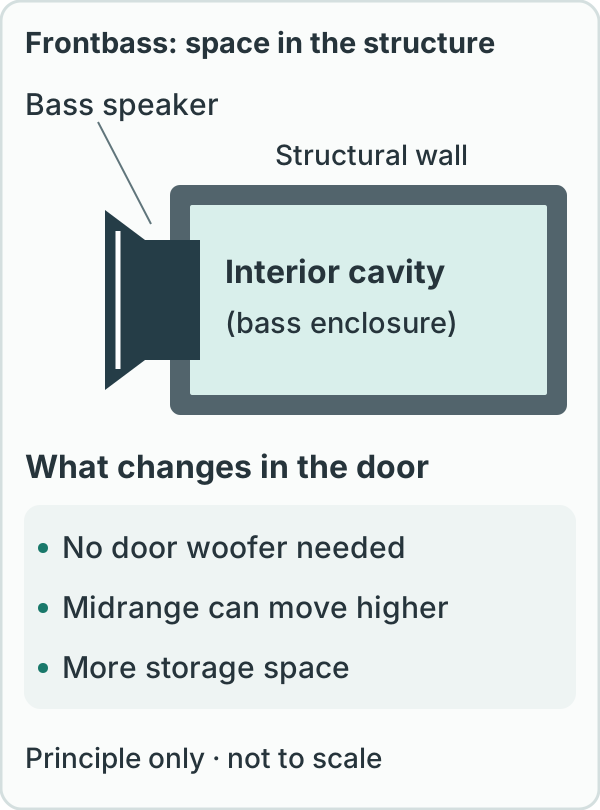
The useful space is inside the structural members. The bass loudspeakers use that volume as their acoustic enclosure; Frontbass is not a scheme for making the whole body vibrate as a loudspeaker. Mercedes-Benz’s technical descriptions identify the cavity as the resonance chamber, with the speaker remaining a separate component. Sources
For the original 2013 S-Class, the manufacturer describes almost 40 litres of space in the crossmember and side members. This is the figure for that 222-series installation, not a common enclosure size for every Frontbass-equipped model. Sources
Moving the woofer changes the door
The S-Class launch material spells out the packaging consequence. With the woofers at the firewall, conventional door-mounted woofers are unnecessary. The door midrange speakers can move higher, and the doors gain storage space. Mercedes-Benz also attributes an improved soundstage to the higher midrange-speaker position. The change is therefore more than an amplifier or speaker-count upgrade: it reorganises where the speakers and their enclosure volume sit in the car. Sources
Frontbass is not another name for Burmester
Frontbass describes the bass-speaker and body-cavity arrangement. Burmester identifies separately specified sound systems. In the 2013 S-Class announcement, Frontbass is common to all audio systems: the standard ten-speaker system and the two optional Burmester systems. The C-Class Coupé and E-Class announcements likewise describe Frontbass separately from optional Burmester equipment. A Burmester badge therefore does not define the underlying Frontbass principle. Sources
Three documented applications
- V222 S-Class long-wheelbase saloon, original 2013 model: the launch description covers the long saloon as well as the standard-wheelbase body, and details the firewall woofers and almost-40-litre structural cavity. A contemporary Hong Kong S 500 long-wheelbase review also describes the firewall-mounted Frontbass speakers. Sources
- C205 C-Class Coupé, 2015 announcement: the manufacturer explicitly describes the bodyshell’s crossmember and side-member volumes as bass-speaker resonance chambers, with Burmester offered as an option. Sources
- W213 E-Class saloon, 2016 announcement: the US release describes the same structural-cavity principle and lists Frontbass as standard, separately from optional Burmester systems. That US equipment designation is not a specification for every Hong Kong variant. Sources
The 222-series did not originate Frontbass. Mercedes-Benz had already described it in an SL advance announcement dated 23 November 2011, using spaces in the aluminium structure ahead of the footwells as bass-speaker resonance chambers. Sources
Sources
- Mercedes-Benz Brasil, “Mercedes-Benz lança novo Classe S: o melhor automóvel do mundo,” 16 May 2013. “Multimídia: uma casa de shows móvel” explains the firewall location, almost-40-litre cavity, door packaging and audio-system distinction; “Conceito” identifies both wheelbases, including the 5,246 mm long saloon.
- Mercedes-Benz France, “La nouvelle Classe C Coupé : Un modèle qui cible le cœur et la raison,” 14 August 2015. “Infodivertissement pour un plaisir de voyager maximal”: original C205 structural resonance chambers and optional Burmester system.
- Mercedes-Benz USA, “The all-new Mercedes-Benz E-Class,” 23 September 2016. “Three-dimensional listening pleasure”: original W213 saloon Frontbass mechanism and US standard/optional audio descriptions.
- DikSirAUTO, “滿載智慧的豪華轎車 - 2013 Mercedes S500,” 9 August 2013. “音效一流的高級音響” and the long-wheelbase test-car description. Used for contemporary Hong Kong technical coverage; the enclosure-volume wording in this article follows the manufacturer rather than the review’s “over 40 litres.”
- Mercedes-Benz, “Mercedes-Benz SL: Well Thought-out Right Down to the Smallest Detail,” 23 November 2011, preserved by The Auto Channel. Manufacturer-authored advance announcement; the final FrontBass passage describes spaces ahead of the footwells, before the 222-series application.