The facelifted 221-series S-Class could counter a crosswind through its hydraulic suspension. On cars equipped with the updated Active Body Control (ABC), the system changed the load distribution between the wheels through the suspension struts. That was a different intervention from applying a wheel brake, and it did not belong to every air-suspended S-Class. Sources
This page covers the 221 family, introduced internationally in 2005 and facelifted in 2009. W221 is the short-wheelbase saloon; V221 is the long-wheelbase saloon. The original bodies measured 5,076 and 5,206 mm long, with wheelbases of 3,035 and 3,165 mm respectively. The explicitly L-badged Hong Kong cars below belong to V221, not W221. Sources
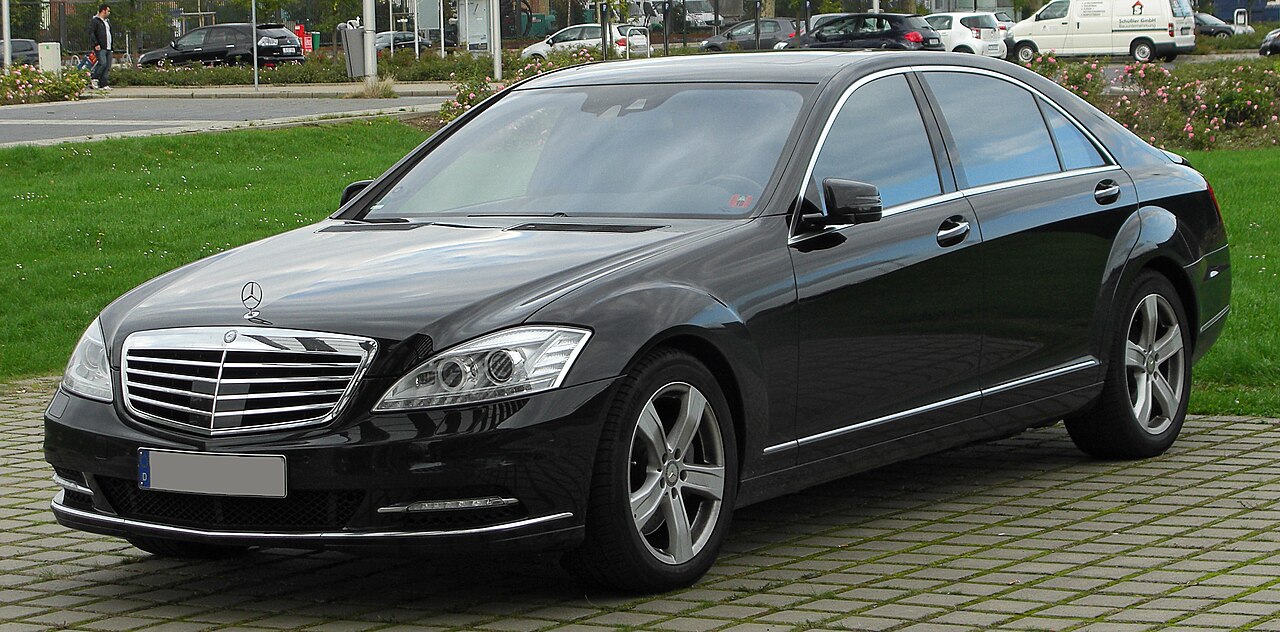

2005 original: two bodies, two suspension systems
Mercedes-Benz presented the new generation at the 2005 Frankfurt motor show, with international sales beginning that autumn. Its sculpted wheel arches, rising shoulder line and descending roofline gave it a markedly different silhouette from the 220 series. Sources
Hong Kong’s contemporary launch coverage dates to 30 September 2005: the South China Morning Post report published on 1 October describes the event as taking place “yesterday.” It lists S350L at HK$1.28 million and S500L at HK$1.49 million, both long-wheelbase V221 names. Sources
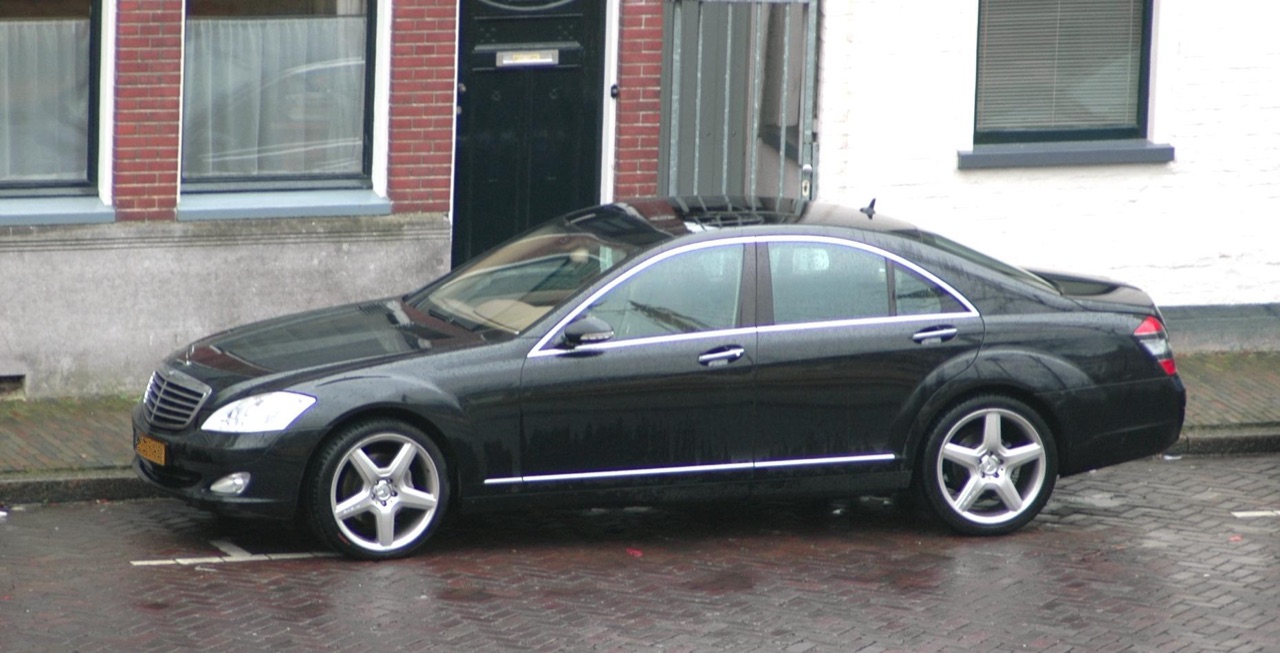

The suspension distinction matters. AIRMATIC used air suspension with adaptive damping. ABC used actively controlled hydraulic plunger cylinders in its four spring struts to oppose body lift, roll and pitch. The manufacturer’s original-generation account describes hydraulic pressure of up to 200 bar, allowing rapid corrections to body movement. ABC therefore already had a way to change the forces supporting the body before crosswind compensation was added in 2009. Sources
The original generation also offered infrared Night View Assist: dedicated infrared lamps illuminated the road for a camera, whose image appeared in the instrument cluster. The facelift’s Night View Assist PLUS added pedestrian highlighting. See the later C218 and V222 comparison for the next steps in this technology. Sources
Two radar fields for distant traffic and nearby queues
The original 221’s optional DISTRONIC PLUS and Brake Assist PLUS package combined a narrow, long-range radar field with a wide, short-range field. The 77 GHz unit looked farther along the road, while 24 GHz sensors covered more of the area close to the car. Their complementary views supplied the controller with information for adjusting engine output, the automatic transmission and braking to follow traffic, including braking to a standstill. This was the internationally documented 2005 launch system. Sources
BAS PLUS used the radar information to calculate braking assistance when the driver braked. DISTRONIC PLUS handled distance-control braking, but after a stop the original system still required the driver to confirm moving off by operating the stalk or briefly pressing the accelerator. The two radar fields expanded coverage; they did not remove the driver’s role. Sources
Massage chambers separate from the seat’s support
The original 221’s optional multicontour-seat technology used eleven air chambers to shape the seat, while a separate set of seven chambers delivered back massage. On dynamic front seats, fast piezo valves also varied side-bolster pressure according to steering angle, lateral acceleration and speed. Keeping the massage chambers separate preserved the chosen support contour during a massage. See the eleven-plus-seven pneumatic-seat arrangement for the chamber and valve mechanism. Sources
NECK-PRO uses a spring to bring the head restraint closer
The documented front NECK-PRO head restraints responded to a recognised rear impact by moving forwards and upwards. A pretensioned spring supplied the movement, bringing support towards the occupant’s head earlier. The 2005 launch description specified 44 mm forwards and 30 mm upwards. This was a crash-responsive head restraint, separate from the seat’s pneumatic contour and massage system. Sources
NECK-PRO’s mechanism could be reset after activation. The 221 manual distinguished standard and luxury versions, with different resetting arrangements, and recommended qualified-workshop checking after deployment. The luxury front version also appeared in the 2009 S63/S65 AMG launch equipment. Sources
The engine keeps idling while the transmission reduces its load
The S320 CDI BlueEFFICIENCY announced internationally in October 2008 had a 7G-TRONIC function called standstill decoupling. When the car stopped with its diesel engine still running, the transmission interrupted power flow to reduce the converter’s hydrodynamic resistance and the load on the idling engine. Mercedes-Benz also described reduced noise and vibration at a stop. This was engine-running load management, rather than automatic engine stop/start. Sources
Releasing the brake called for a slip-controlled clutch to engage again, restoring drive for moving off. The manufacturer offered this late pre-facelift diesel variant in both wheelbases for an end-2008 introduction; that precise variant is the example here. Sources
2009 facelift: documented in Hong Kong by September
The international facelift announcement was dated 8 April 2009, with showrooms scheduled to receive cars from June. Hong Kong’s contemporary reports establish a separate local milestone: a facelifted S350L had arrived and been tested by 6 September, and Car1.hk’s 7 September 2009 announcement listed the following cars as already on sale. These are dated availability records, not an exact first-delivery date. Sources
| Local record | Hong Kong sales name | Body mapping | Period price |
|---|---|---|---|
| By 2009‑09‑07 | S 300 L | V221, long | HK$1,099,000 |
| By 2009‑09‑07 | S 300 L Star Edition | V221, long | HK$1,158,000 |
| By 2009‑09‑07 | S 350 | Wheelbase not specified in price list | HK$1,378,000 |
| By 2009‑09‑07 | S 350 L Star Edition | V221, long | HK$1,439,000 |
| By 2009‑09‑07 | S 500 | Wheelbase not specified in price list | HK$1,628,000 |
| By 2009‑09‑07 | S 500 L Star Edition | V221, long | HK$1,678,000 |
| By 2009‑09‑07 | S 600 L | V221, long | HK$2,482,000 |
| By 2009‑09‑07 | S 63 AMG | Local wheelbase not specified | HK$2,632,000 |
| By 2009‑09‑07 | S 65 AMG | V221; manufacturer offered long only | HK$3,495,000 |
The names and prices follow the contemporary Hong Kong list. Internationally, S 63 AMG came in both wheelbases; S 65 AMG was long-only. An omitted L in a local listing is therefore not sufficient to identify a short W221. Sources
The local S350L test recorded a 5,226 mm body, a 3,498 cc V6 with 272 hp, and 7G-TRONIC. Its longer facelift body measurement should not be confused with the original long body’s 5,206 mm. The facelift also brought a revised grille and bumpers, LED rear lamps and exhaust outlets integrated into the rear bumper. Sources
Crosswind compensation: change wheel loads, not brake pressure
The updated ABC reused ESP’s yaw-rate and lateral-acceleration sensor signals. Yaw describes the car turning around its vertical axis; lateral acceleration describes its sideways response. According to the direction and intensity of the crosswind, ABC adjusted the wheel-load distribution through its spring struts within milliseconds, helping counter the disturbance. The actuators were the hydraulic suspension struts, rather than an air spring simply switching to a firmer damping setting. Sources
The separate Torque Vectoring Brake used a different actuator and addressed a different situation: it braked the inside rear wheel in a bend, creating a turning moment to help the car turn in. Both features appeared in the facelift material, but the brake intervention was not the mechanism behind ABC’s crosswind compensation. Sources
The May 2009 international release listed crosswind-capable ABC as optional on rear-wheel-drive eight-cylinder models and standard on S 600; the archive also records it as standard on the contemporary S 63 AMG and S 65 AMG. Hong Kong’s September coverage advertised the system for eight- and twelve-cylinder cars. That establishes a local offering, rather than a complete Hong Kong standard-equipment matrix. The six-cylinder S300L and S350L are not included in this ABC claim. Sources
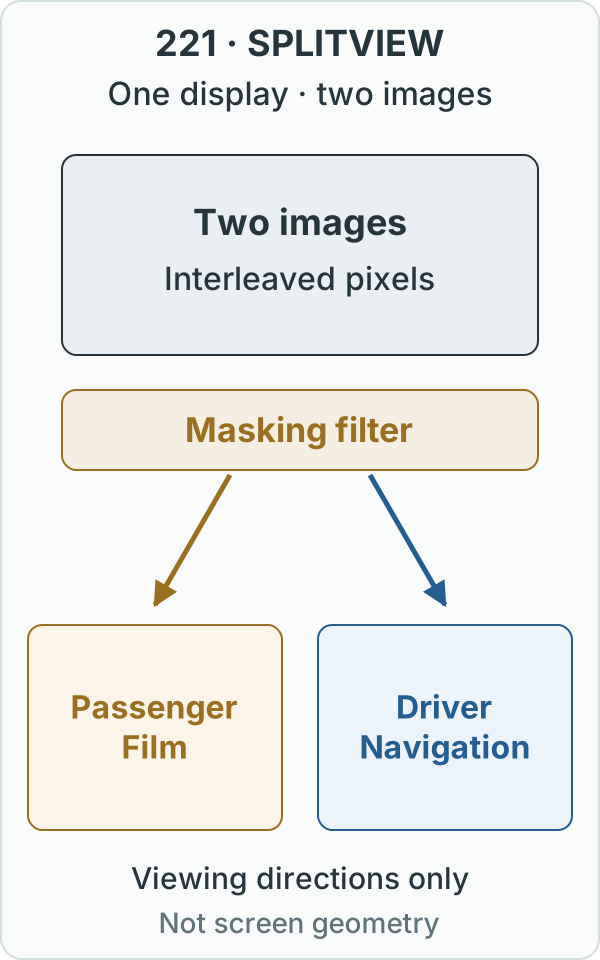
SPLITVIEW: one screen, two viewing directions
SPLITVIEW let the driver see navigation while the front passenger watched a film on the same central display. Pixels belonging to the two pictures were placed next to one another. A masking filter over the display separated the mixed image by viewing direction, so each seating position saw the appropriate set of pixels. The separation was optical, rather than two software windows sharing the screen. The passenger could select entertainment by remote control and listen through headphones while the driver retained COMAND information. Sources
The system belonged to the 2009 facelift era. A Hong Kong S350L test published on 25 October 2009 explicitly showed its remote-control selector and named SPLITVIEW. That gives a locally documented long-wheelbase V221 example of the same-screen, different-image idea. Sources
Direct-Steer: the ratio changes in the rack
The facelift-launch S63 AMG with the M156 V8 and S65 AMG with the M275 V12 used Direct-Steer, a mechanically variable-ratio steering rack. Around the straight-ahead position, a less direct ratio favoured steady tracking; as steering angle increased, the ratio became more direct, reducing the handwheel movement needed for tighter bends and urban manoeuvres. The ratio change came from the rack’s mechanical design, rather than an extra actuator varying it. Sources
Speed-sensitive assistance was a separate layer: it supplied more help at low road speeds and less at high speeds. A steering system could therefore vary its ratio mechanically while still varying its power assistance with speed. Hong Kong’s September 2009 launch report described Direct-Steer and listed both AMG models locally. Sources
Later engine changes were not the facelift itself
The 2009 facelift S 350 still used M272, the S 500 used the naturally aspirated M273 5.5-litre V8, and the S 63 AMG retained its M156 6.2-litre V8. Further changes followed: in late summer 2010, S 63 AMG adopted the M157 5.5-litre biturbo V8 and MCT transmission; for the 2011 model year, S 350 BlueEFFICIENCY and S 500 BlueEFFICIENCY introduced M276 V6 and M278 biturbo V8 engines. Those are international chronology points; their Hong Kong introduction months remain unestablished. Sources
S 400 HYBRID also spans generations. The 221 version had an M272.974 petrol engine rated at 205 kW, a 15 kW motor, and a hydraulic torque converter with lock-up clutch. The archive identifies the short car as 221.095 / W221 and the long car as 221.195 / V221. Its Hong Kong retail introduction is not established by the September list. The later 222-series S 400 HYBRID is a separate drivetrain, not another name for this car. Sources
When battery cooling takes priority over the A/C button
The North American 2010 S400 HYBRID manual supplement describes a less visible job for the air-conditioning system: cooling the high-voltage battery. If the battery’s operating temperature became too high, the climate system switched the A/C on automatically. For several minutes, the driver could not switch it off through COMAND. The request for cooling came from battery temperature, rather than solely from the chosen cabin temperature. Sources
The same manual places climate operation in the car’s operational, READY-indicated state. It could maintain the selected cabin temperature temporarily after an automatic engine stop. The battery and cabin therefore shared the climate system’s cooling capacity while the hybrid remained operational. See engine-off climate control for the distinction between operating refrigeration and residual-heat or ventilation functions. Sources
Sources
- Mercedes-Benz Public Archive, “221 series S-Class Saloons, 2005–2009”. International introduction, original dimensions and design, AIRMATIC, hydraulic ABC and W221/V221 image identifications.
- Mercedes-Benz, 2006 Mercedes-Benz S Class Press Kit, 9 August 2005, preserved by The Auto Channel. International-range material: “Night view assist”; “Brake Assist PLUS: two radar systems looking ahead” and “Evolution: two radar systems for long and short range”; “Pneumatics: fit for PRE-SAFE with fast piezo valves,” “Dynamic multicontour seat” and “Head restraints: crash-responsive with movable side bolsters.” Infrared imaging, radar/control coverage, separate contour/massage chambers and spring-driven front NECK-PRO.
- Mercedes-Benz, “The 2009 Mercedes-Benz S-Class: Setting the Standard in the Luxury Class,” 8 April 2009, preserved by The Auto Channel. International facelift schedule, crosswind compensation, Night View Assist PLUS and exterior changes.
- Mercedes-Benz, “The 2009 Mercedes-Benz S-Class: Pacemaker in Automotive Development,” 11 May 2009, preserved by The Auto Channel. “New: Active Body Control reduces the effect of a crosswind” distinguishes ABC fitment, sensor inputs and strut action from Torque Vectoring Brake.
- Car1.hk, “永恆的延續 – 新一代平治 S 正式發布,” 7 September 2009. Contemporary Hong Kong announcement, explicitly L-badged versions, local prices and ABC offering; credits Mercedes-Benz Hong Kong and Zung Fu.
- Oriental Daily / 林健森, “Mercedes Benz S Class豪華升格,” 6 September 2009. Local S350L arrival/test, 5,226 mm length, V6 powertrain and crosswind-capable ABC offering.
- Mercedes-Benz, S-Class Owner’s Manual, 2215847882Z102, printed pp. 257–260 (AIRMATIC/ABC), p.45 / PDF p.48 (front NECK-PRO), p.394 / PDF p.397 (standard/luxury resetting and post-activation checking). Manufacturer-hosted German-market/all-options operating manual.
- Mercedes-Benz Public Archive, “221 series S-Class Saloons, 2009–2013”. Crosswind and brake mechanisms, AMG wheelbases/equipment, and separate 2010/2011 powertrain changes.
- Mercedes-Benz Public Archive, “S 400 HYBRID, 2009–2013” and “S 400 HYBRID long wheelbase, 2009–2013”. W221/221.095 and V221/221.195, M272.974, separate engine/motor ratings and torque-converter transmission.
- South China Morning Post, “Sleek and not for the meek,” 1 October 2005. The report dates the launch to “yesterday,” establishing 30 September, and gives S350L/S500L prices. This is the launch event, not a customer-delivery date.
- Daimler Communications, Innovative SPLITVIEW technology, 10 December 2008, manufacturer release preserved by motormove / Schwab-Kolb. Adjacent image pixels, masking filter, driver/passenger viewing directions and remote/headphone operation; planned S-Class introduction in summer 2009.
- Car1.hk, MERCEDES-BENZ S350L 2010:永恆經典, 25 October 2009. Hong Kong long-wheelbase S350L test identifies SPLITVIEW and its remote-control selector. Local equipped example.
- Mercedes-Benz / Mercedes-AMG, Specific Enhancements to the S 63 AMG and S 65 AMG, 23 June 2009, preserved by The Auto Channel. “Crosswind stabilisation, Torque Vectoring Brake and Direct-Steer system” and “New standards in active and passive safety”; facelift-launch AMG variable steering ratio and SPLITVIEW application. S63 AMG was offered in both wheelbases; S65 AMG was long-only.
- Thomas Philips, eMercedesBenz, 2010 Mercedes-Benz S63 AMG and S65 AMG: AMG Sports Suspension and Braking System, 22 June 2009. Detailed period press-style technical text: mechanical variable-ratio rack and separately speed-sensitive power assistance.
- Mercedes-Benz, S400 HYBRID Operator’s Manual Supplement, 2215844887, Edition A 2010, printed p.19 / viewer p.21, page timestamp 13 May 2009. North American 221-generation supplement: battery-triggered automatic A/C activation, temporary COMAND shut-off restriction and READY-state climate operation.
- Mercedes-Benz, Mercedes-Benz S320 CDI BlueEFFICIENCY: The Most Frugal S-Class Ever, 1 October 2008, preserved by The Auto Channel. International late original-phase diesel variant, both wheelbases: engine-running standstill decoupling, reduced converter resistance and slip-controlled recoupling on brake release.