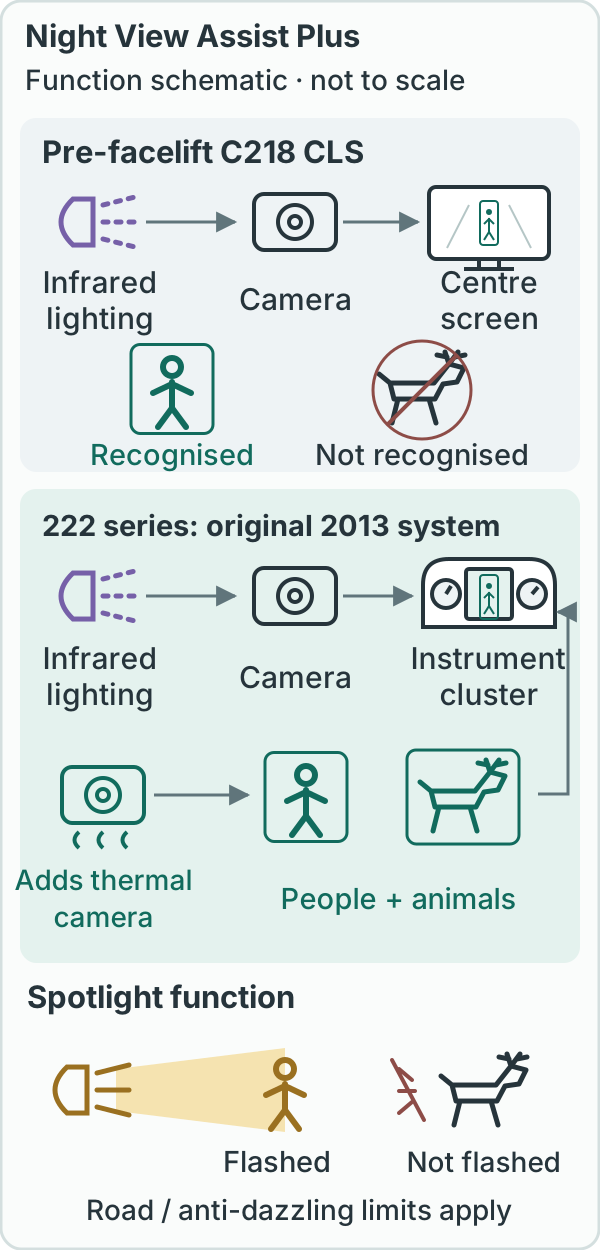
The original C218 CLS illuminated the road with invisible infrared light; the original 222-series S-Class added a separate thermal camera. Both were called Night View Assist Plus, but their hardware and recognition functions were not the same. The comparison here concerns the pre-facelift C218 CLS and the original 2013 system offered in the 222 series, including the long-wheelbase V222 S-Class. Sources
C218: an infrared-lit image on the centre screen
The CLS system used active infrared illumination: infrared headlamps lit the road, and a camera at the top of the windscreen picked up that light. The driver saw a black-and-white road image on the COMAND APS central display, not a thermal image on the instrument cluster. Because people cannot see the infrared illumination, the system could remain switched on with oncoming traffic, when ordinary main beam would be inappropriate. Sources
The cited CLS owner’s manual gives a practical catch for a stationary demonstration: the infrared headlamps only switched on at 10 km/h or above. It therefore says the full visual range was unavailable while stationary. Switching on the screen alone did not demonstrate the system’s complete operating view. Sources
Its pedestrian recognition was another layer on top of the image. Under the specified dark-road conditions and above about 10 km/h, the system looked for characteristics such as a human silhouette and framed recognised pedestrians on the screen. Animals were not recognised by this pedestrian-recognition function. An animal being visible in a road image is not the same as software recognising it as an animal. Sources
V222: two cameras with different jobs
The original 222 system retained a camera high on the windscreen and added a thermal camera behind the radiator grille, on the vehicle’s right-hand side. It still used infrared illumination at night. The service introduction separates the cameras’ recognition roles: camera 1 supplied the road image and pedestrian information but did not recognise animals; camera 2, the thermal camera, served recognition of both people and animals. The processed night view appeared in the instrument cluster. Sources
That is the important hardware change: animal recognition was not simply a new label attached to the CLS’s existing image. The 222 system had an additional type of camera, and could highlight recognised people and animals on the display. Sources
Recognising an animal does not mean flashing it
The spotlight function was a separate visible-light action. The 222 brochure describes four rapid flashes towards an at-risk pedestrian, drawing the driver’s attention and alerting the person. Recognised animals were not flashed: the service introduction explains that their response to pulsed light was unpredictable. Sources
Spotlight operation was restricted to unlit roads outside built-up areas and had to avoid dazzling traffic ahead or approaching from the opposite direction. Recognition on a screen did not therefore imply that a visible spotlight would operate on a lit urban street. Sources
Automatic display is not automatic braking
With the 222 system’s automatic image display enabled, the night view could appear when people or animals were detected on an unlit road, then disappear when the relevant detection area was clear. Recognition remained active in the background. Manual selection could keep the image displayed; the service book also distinguishes a manually selected daytime image from night-time person and animal recognition. Sources
These are distinct operations: forming an image, recognising a subject, bringing up the screen and flashing a pedestrian. None is an automatic-braking command. The 222 service publication describes automatic braking separately under PRE-SAFE Brake, using radar sensors and the stereo multifunction camera. Sources
Equipment scope
Period manufacturer brochures list Night View Assist Plus as optional on both generations. These overseas technical and sales documents explain the systems; exact Hong Kong ordering availability and individual-car fitment are not established here. Sources
Sources
- Mercedes-Benz, CLS Owner’s Manual, document 2185840281Z102, printed pp. 180–181 / PDF pp. 183–184: active infrared illumination, upper-windscreen camera, COMAND APS display, 10 km/h illumination threshold, pedestrian recognition and explicit exclusion of animals from that recognition. German-market operating documentation covering optional equipment.
- Mercedes-Benz, The CLS-Class, period English brochure, printed p. 46 / PDF p. 48: Night View Assist Plus listed as an option, with an infrared-camera greyscale image on the central display. Manufacturer brochure preserved by Ragtop; not a Hong Kong order guide.
- Daimler AG / Mercedes-Benz Service, Einführung neue S-Klasse, Typenreihe 222, HLI 000 000 1214, technical status February 2013, printed April 2013. Printed pp. 97–99 / PDF pp. 98–100: camera positions, thermal camera, instrument-cluster image, separate recognition roles, automatic/manual display modes, pedestrian spotlight, animal-flashing exclusion and operating conditions. Printed p. 85 / PDF p. 86: separate PRE-SAFE Brake operation and sensors. Printed p. 5 / PDF p. 6 identifies both W222 and long-wheelbase V222 launch models. Manufacturer service introduction preserved by Motor-Talk.
- Daimler AG, The S-Class, July 2013 brochure, printed p. 49 / PDF p. 51: optional Night View Assist Plus, people and animals shown in the instrument cluster, four pedestrian spotlight flashes and automatic night-view display. Period production brochure; not a Hong Kong equipment list.