X166 covers the second-generation GL and its facelift, renamed GLS. The name change did not create a new chassis generation. The five-seat W166 ML / GLE is a separate body in the same 166 family. Sources
A cushion that moves as the backrest folds
The third row has two individual seats that fold electrically into the load area. Under each seat, a four-bar linkage supports the cushion, while connecting rods link it to the pivoting backrest. As the backrest folds, the cushion moves down and forwards. The backrest surfaces and two additional covers then form a nearly level load floor, without removing the seats. Each seat has separate electric drives for locking/unlocking and folding. Sources
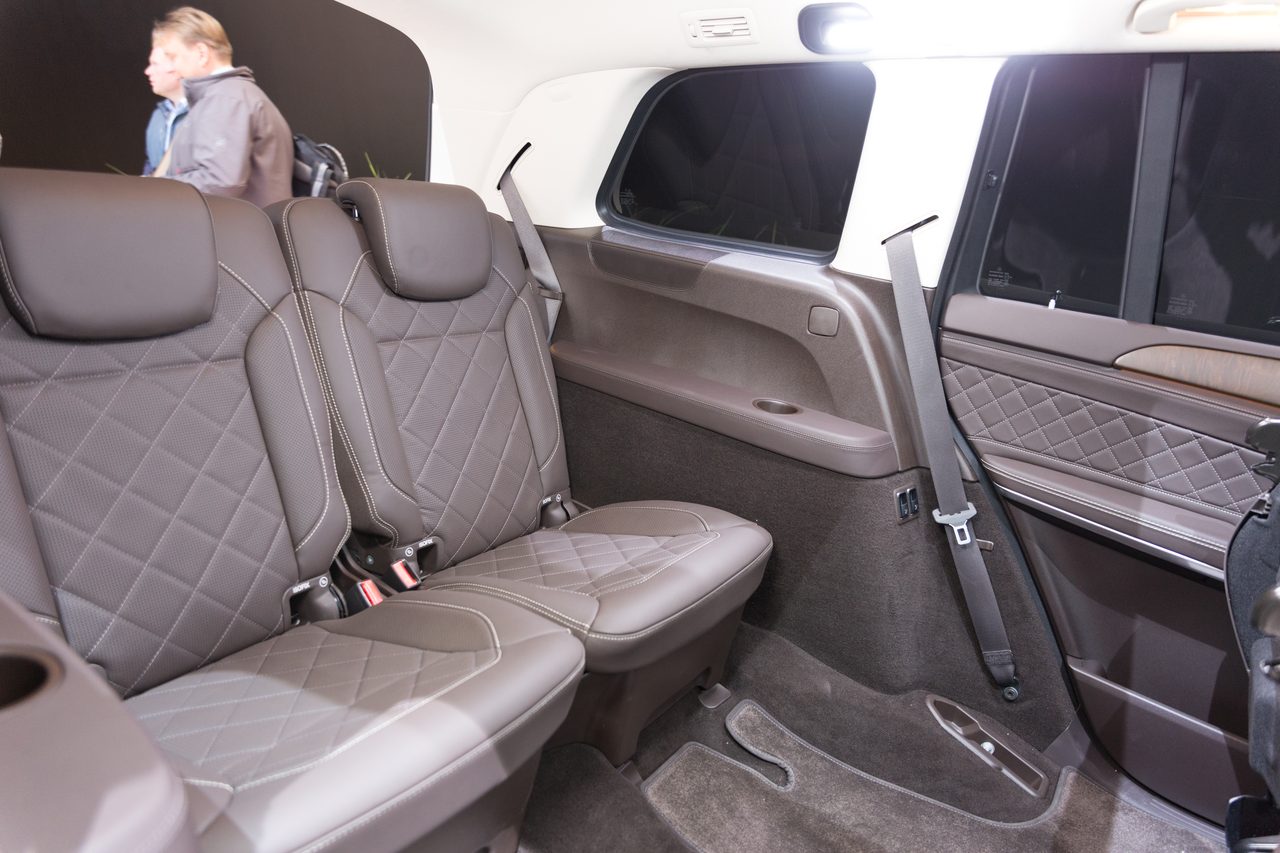

EASY-ENTRY makes an access opening in the second row. In the original optional electric version, actuators release a spring-preloaded movement: the head restraint retracts, the backrest folds onto the cushion and the whole outer seat tips forwards. The owner’s manual specifies a manual return to its original position. This is a different mechanism from lowering the third row into the floor. Sources
Mercedes-Benz Hong Kong’s May 2013 GL release described electric third-row operation as standard and electric EASY-ENTRY as optional. Its April 2014 GL 63 AMG release listed electric EASY-ENTRY as standard on that model. Sources
With the third row folded, the original GL provided 680 litres behind the second row, measured up to its backrest height. Sources
ESP takes the load into account
The original GL’s load-recognition system adapted ESP intervention thresholds to the vehicle’s actual load situation. That is a control adjustment beyond AIRMATIC keeping the body level: the stability system changes its thresholds as the load changes. The 2012 technical introduction lists air-suspension load recognition for ECE-market cars and excludes the USA; Hong Kong’s April 2013 GL announcement also names ESP load recognition. Sources
Hydraulic torque at the anti-roll bars
The optional ACTIVE CURVE SYSTEM uses front and rear active anti-roll bars with two hydraulic rotary actuators. Its control unit adjusts hydraulic pressure using lateral acceleration as a principal input, so the bars apply controlled torque to oppose body roll in bends. AIRMATIC’s air springs continue to support and level the vehicle. See how ACTIVE CURVE SYSTEM works. Sources
Low range changes the mechanical reduction
The original GL’s optional ON&OFFROAD package adds a transfer case with 1:1 high range and 2.93:1 low range. The extra reduction increases drive torque and lowers wheel speed for a given gearbox ratio. Its centre differential lock acts between the axles; front and rear axle differentials remain open, with 4ETS using selective braking to control wheel traction. The ON&OFFROAD explanation follows those separate functions. Availability varies by model and phase. Sources
Rear cooling has its own hardware
The original international equipment description offered an additional rear air-conditioning system alongside three-zone THERMOTRONIC. It placed an extra evaporator in the left rear of the body to cool the third row. Temperature and blower settings for that row followed the second-row settings, giving the third row its own cooling hardware within the existing rear control zone. Sources
Four cameras create the overhead view
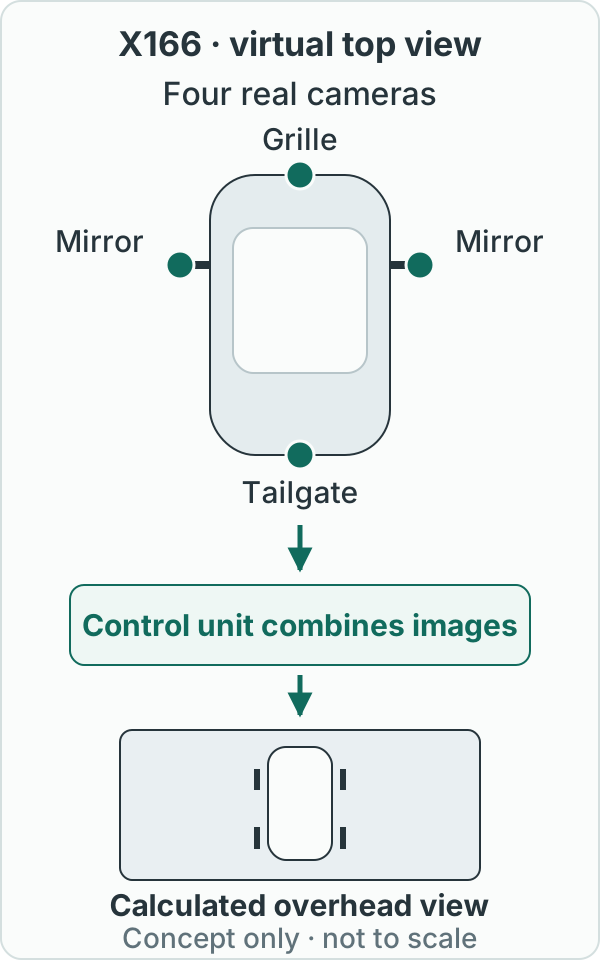
The optional 360° camera combines images from a camera in the grille, one in the tailgate and one in each exterior mirror. A control unit assembles those four views into a virtual viewpoint above the vehicle, so the driver can see its edges and immediate surroundings on COMAND. The overhead view is calculated from the installed cameras. Sources
A May 2013 Hong Kong GL 500 test described switching between camera views to help with parking and inspecting rough ground. Mercedes-Benz Hong Kong listed the system as optional. The manual also identifies areas the cameras cannot show, including under the front and rear bumpers and very close to either bumper. Sources
Off-road lighting spreads the beam
The original X166’s optional off-road lighting changed the headlamps’ physical beam pattern. With the relevant ON&OFFROAD equipment, selecting Off-Road 1 or Off-Road 2 pivoted the bi-xenon modules 6° outwards, producing a wider, symmetrical dipped beam; the LED cornering lamps stayed on. This illuminated more of the ground to either side during low-speed manoeuvres. Sources
The original GL manual limits this lighting function to 50 km/h or below and describes the cornering lamps remaining active while the active bend-light function is suspended. Mercedes-Benz Hong Kong’s May 2013 release also offered bi-xenon Intelligent Light System headlamps with the new off-road light. Sources
STEER CONTROL gives a steering cue
STEER CONTROL applies a noticeable force at the steering wheel in the direction that helps stabilise the vehicle. The original GL manual describes two examples: braking when the wheels on one side are on a wet or slippery surface, and a vehicle beginning to skid. The driver feels a corrective steering cue and remains responsible for steering. Mercedes-Benz Hong Kong included the system in its original GL equipment description. Sources
An ESP fault removes STEER CONTROL’s corrective cue, while ordinary power steering continues to work. Sources
Crosswind Assist acts through the brakes
The original GL’s Crosswind Assist uses targeted brake applications to counter a gust’s effect on the vehicle’s course. Integrated into ESP, it responds according to the wind’s direction and intensity. Mercedes-Benz Hong Kong listed Crosswind Assist as standard in May 2013. Sources
The original German-market manual describes operation above 80 km/h, on straight roads or gentle bends, with ESP available and switched on. Sources
Hong Kong: GL becomes GLS


| Date | Documented local milestone Sources |
|---|---|
| April 2013 | A report on 20 April stated that the GL 500 was on sale in Hong Kong, from HK$1,384,000. Mercedes-Benz Hong Kong’s 10 May release also listed the model. |
| April 2014 | The manufacturer’s 10 April Hong Kong release listed the GL 63 AMG 4MATIC at HK$2,268,000. |
| March 2016 | The 14 March local GLS announcement named GLS 400, GLS 500 and Mercedes-AMG GLS 63. The first two used 9G-TRONIC; the AMG retained AMG SPEEDSHIFT PLUS 7G-TRONIC. |


The GL made its world premiere in New York in April 2012, a year before the Hong Kong GL 500 on-sale report above. Sources
Sources
- Mercedes-Benz Public Archive, 166 series GL-Class, 2012–2015, manufacturer history: X166 identity, April 2012 premiere, load-adapted ESP and GLS renaming.
- Daimler AG, Einführung neue GL-Klasse, Typenreihe X166, June 2012, order 6516 1394 00, printed p. 10 / viewer p. 11: W166 basis and ECE/USA load-recognition scope. Original manufacturer publication preserved by ManualsLib.
- Daimler AG, X166 technical introduction: third row, printed p. 30 / viewer p. 31: four-bar linkage, connecting rods, drives and near-level floor.
- Daimler AG, X166 technical introduction: electric EASY-ENTRY, printed p. 31 / viewer p. 32: actuator release and spring-preloaded second-row movement.
- Mercedes-Benz, GL Owner’s Manual, 1665840781Z102, printed pp. 68, 70, 105–108, 124, 228–229 / PDF pages +3: Crosswind Assist, STEER CONTROL, third-row folding and second-row access, off-road lights, and the calculated 360° camera view and blind areas. German-market manual including optional equipment; operating conditions refer to the documented original GL system.
- Daimler AG, X166 technical introduction: luggage compartment, printed p. 33 / viewer p. 34: 680 litres behind the second row with the third row folded, measured to backrest height; further configurations on printed p. 34 / viewer p. 35.
- Daimler AG, X166 technical introduction: Klimatisierung, printed p. 82 / viewer p. 83: optional three-zone THERMOTRONIC and additional rear evaporator; international technical description, not a Hong Kong order guide.
- Car1, Mercedes-Benz GL 全方位享受, 20 April 2013, explicit Hong Kong GL 500 on-sale statement and ESP load recognition. The prose and attached specification table conflict on power output; no engine-upgrade chronology is inferred.
- Mercedes-Benz Hong Kong, The new Mercedes-Benz GL-Class: First class in all conditions, 10 May 2013, manufacturer-authored release preserved by 1888PressRelease: GL 500 offering, seat-operation equipment scope, standard Crosswind Assist and STEER CONTROL, and optional 360° camera and bi-xenon ILS with off-road lighting.
- Mercedes-Benz Hong Kong, The New Mercedes-Benz GL 63 AMG: Perfect Blend Of Style And Performance, 10 April 2014, local list price and standard electric EASY-ENTRY.
- Car1, Mercedes-Benz GLS 大型旅行車抵港開賣 $1,099,000 起, 14 March 2016, dated Hong Kong GLS announcement, three variants and transmission distinction.
- Mercedes-Benz Hong Kong / Zung Fu, 全新平治GLS糅合平治GL與S系列–極致路面與越野表現, manufacturer release preserved by 28car; separate ACTIVE CURVE and Off-Road Engineering options. Undated; not used to establish the announcement day.
- Daimler AG, Einführung neue GL-Klasse, Typenreihe X166, June 2012: ACTIVE CURVE SYSTEM, order 6516 1394 00, printed p. 56 / viewer p. 57: two hydraulic rotary actuators, pressure control and lateral acceleration input. Original manufacturer technical publication preserved by ManualsLib.
- Daimler AG, Einführung neue GL-Klasse, Typenreihe X166, June 2012: ON&OFFROAD, order 6516 1394 00, printed p. 58 / viewer p. 59: high/low reduction ratios, lockable centre differential, open axle differentials and adapted 4ETS.
- Daimler AG, Einführung neue GL-Klasse, Typenreihe X166, June 2012: 360° Kamera, order 6516 1394 00, printed p. 80 / viewer p. 81: four camera locations, control unit and composite virtual viewpoint. Original manufacturer technical publication preserved by ManualsLib.
- Daimler AG, Einführung neue GL-Klasse, Typenreihe X166, June 2012: Off-Road-Lighting, order 6516 1394 00, printed p. 70 / viewer p. 71: optional ON&OFFROAD-linked lighting, 6° outward bi-xenon movement, cornering lamps and the 50 km/h operating limit. Original X166 technical scope.
- Teddy Leung, Car1, Mercedes-Benz GL 500 4MATIC 豪旅現身, 10 May 2013, “360 度環視鏡成新焦點” and its camera caption: local test-car display, four-camera views and the reviewer’s parking/rough-ground observations.